Thursday, 6 September 2012

Azores Day 5

Back in the field today for the last time (lab day tomorrow) at two sites in the centre of the island, Lagoa do Fogo and Caldeira Velha. As usual, the weather was not great at Lagoa do Fogo....

The bus overheated on the steep climb

Lagoa do Fogo

Working on the hillside

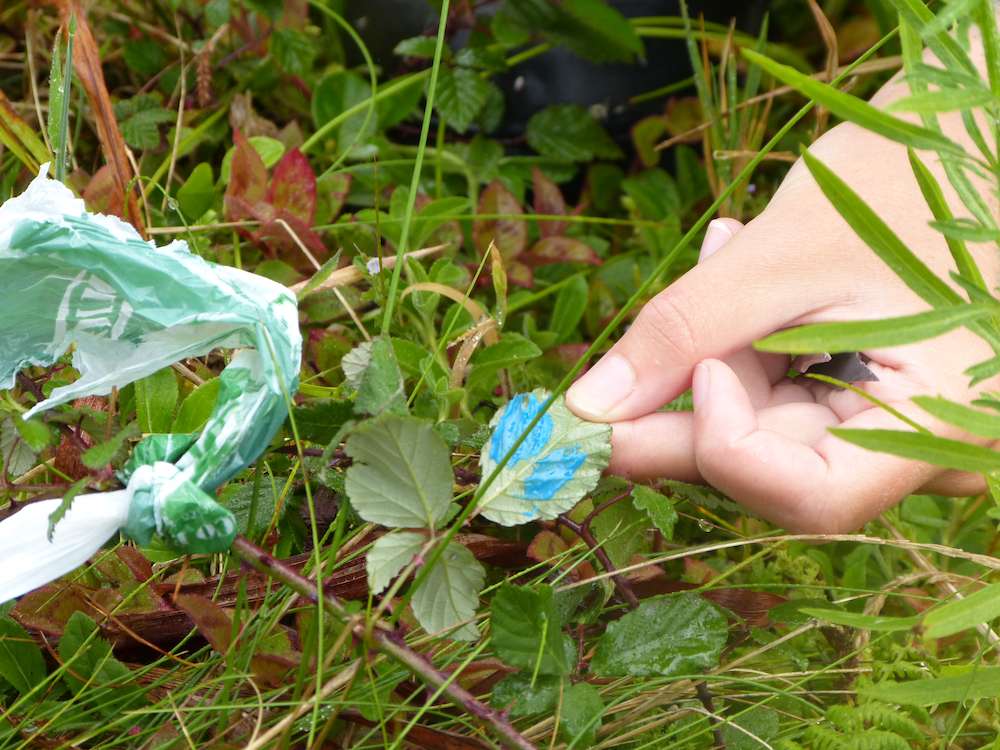
Today was all about looking at whether there are any differences between the endemic and invasive plants that give the invasives some sort of advantage. Field measurements included chlorophyll fluorescence using a PEA (photosynthetic efficiency analysis) meter, leaf thickness and we also took  leaf impressions (using a dental product) to look at stomatal density in the lab tomorrow.


Working on the steep crater rim
above the lake
Taking "dental" impressions of the undersides
of the leaves of one of the endemic
trees, Laurus azorica.

Noting leaf dimensions.
Hedychium gardneranium - an invasive plant


A masterclass in keeping your notebook dry.


Innovative use of PEA meter clips.


Leaf impressions


 Further down the volcano, at Caldeira Velha, a different selection of plants provided further data while the "thermal" pool allowed a surprisingly cold swim!

Caldeira Velha
Some flexed their muscles...


...others felt compelled to bring
inflatable elephants.


Some even felt compelled to dance......

Every day we are seeing what seem like familiar species but most of them are endemic species or subspecies and look a little different:

"Atlantis" (Azorean) Herring Gull
Sao Miguel Grayling (Hipparchia miguelensis)


On the way back to the university for food, several of the staff made a detour to the coast for a fruitless search for an endemic water beetle in the pools in the splash zone. Maybe next year...


Wednesday, 5 September 2012

Azores Day 4

As well as work in the field, we do some work in the lab on this field course and today was the first of our lab days. This is only possible thanks to the kind hospitality offered to us by the biology department here at the Univesidade dos Açores

The two lab activities that we do are based around the work on the first day. Firstly, we look at the potential for pesticide resistance due to over use of deltamethrin in Pseudaletia caterpillars using an esterase protocol.

John Moody demonstrating our portable spectrophotometers, and one of the groups following the protocol.


Secondly we look for both Cyanobacteria and E. coli/Enterococcus in the lake and bathing water we collected on Sunday/Monday. 


Checking the samples under the microscope and identifying key organisms.


The University campus offers a nice setting for lunch!

John "Comedy Grandad" Moody scientifically testing the
consistency of upside-down rice pudding!


Tuesday, 4 September 2012

Azores Day 3

Our third day on the Azores was also our longest. We were off at 8 AM to travel all the way across the island to Serra da Tronqueira near Nordeste. This area is the last remaining habitat for the Azores Bullfinch, a Sao Miguel endemic. The species has suffered in the past from loss of its Laurisilva forest habitat due to the planting of Cryptomeria japonica as well as other factors. The world's population is a mere 1200–1500 pairs.  

Cryptomeria japonica was planted as a source of timber and forms thick, dark forests where the Bullfinch's native food plants cannot grow. A recent project has allowed clearing of an area of Cryptomeria and the area has been replanted with native tree species of the Laurisilva forest. Many of the plants of the Laurisilva forest are endemic to the Azores (a few examples are shown below).

We have been monitoring the vegetation of this area since 2008, and today we visited for our annual Plymouth University survey to see how the trees were growing and assess the other species present. Invasive species are a big problem in the Azores, and the team managing this area has been fighting hard to control several aggresive plants like the ginger lily, Hedychium gardnerianum. Nevertheless, native species have also been arriving over the years, including several endemic species.

Once we had completed the survey, we visited one of the few remaining bits of mature laurisilva forest. Some of the group decided to walk most of the way home along the forest track. Although not everyone saw the endemic bullfinch, quite a few people did. We estimated that at least ten bullfinches were seen today. Not bad given the number of people and the noise!


The reforestation area with Cryptomeria in the background

Paul helping students monitor their plots
Surveying plots (not standing round 'onest guv)
Who knew you could have so much fun with string and a tape measure on a mountain?

Laurisilva forest on Pico da Vara

Priôlo (Azores Bullfinch)
Laurus azorica


Juniperus brevifolia

Vaccinium cylindraceum


Ilex perado ssp. azorica
Erica azorica


Paul "Thor" Ramsay wields his mighty hammer.

Not quite Rio...

One of the survey teams, possibly the most thorough... or maybe the slowest.

Azores Day 2

Day 2 saw our trip to the town of Furnas, the most geologically active part of the island. Students took some water samples to look for Cyanobacterial blooms from the lake (which showed clear signs of a significant bloom that was probably just finishing). We also looked around some of the clear boilers and mud pots where water, heated by geothermal activity, rises to the surface. Some people use this geothermal activity to cook food in holes in the ground!

The first stop on the tour was the caldera lake in the crater. Several of the students took their water samples, and everyone had a chance to look around the boiling pools and see some of the characteristic formations produced by the water chemistry and extremophiles.


Geothermal area
Deposits of sulfur

Furnas Lake
Ferric hydroxide deposits formed by iron oxidising Bacteria

From the lake, we moved on to the town of Furnas where there are many boilers and mud pots, as well as springs that deliver waters of varying taste (some horribly sulphurous). During a tour of the town, we took more water samples and took notes on the biology of the thermal springs.

Briefing in Aunty Silvia's foot spa.

Looking at extremophile communities near the
Furnas microbiological observatory.


Sacks of maize cooking in a thermal pool, and adding
organic material to water that normally does not contain
it. This has serious consequences for some of the
organisms that live downstream.


Hillside constructed from silicate deposits produced
over many, many years by microbial action.


Caldeira grande

One of the many pools in Furnas.


The mineral water springs have different temperatures, water chemistry and
biological characteristics.


Then it was on to the Furnas Botanic Gardens to look at their collection of endemic plants in preparation for tomorrow's survey of a Laurisilva forest restoration scheme. There was also the opportunity for a quick swim in the thermal pool (and take a few water samples for analysis later in the lab).


Looking at endemic plants


Thermal swimming pool at Furnas Botanic Garden.

Azores race of Goldcrest


Finally, we returned to the university to eat, where a Lesser Yellowlegs (a vagrant American species) was frequenting the ponds in the gardens. 


Azores Field Course Day 1

Some of us are currently on the Azorean island of São Miguel with the second year BSc Biological Sciences and Environmental Biology students. The field course concentrates on various aspects of island biology with particular emphasis on anthropogenic effects as well as on the unique micobiological fauna of the area.

We will try to post some brief updates daily to show readers what kinds of things we are up to.

One of the activities on the first day is to set up a suitable sampling strategy for monitoring the caterpillars of the moth Pseudaletia unipuncta. These can be a pest on the island eating valuable pasture land. As much of the local farming economy relies on dairy cattle, grass losses to the caterpillars can influence yields.

Monitoring of Pseudaletia unipuncta caterpillars

The second activity of the day is also related (partly) to dairy farming and consists of taking water samples from the caldeira lakes Lagoa Verde and Lagoa Azul at Sete Cidades. Run off from dairy pastures can increase the possibility of eutrophication of these lakes and can contribute to cyanobacterial blooms. Water samples will be analysed later in the week for cyanobacteria and the presence of faecal bacteria.

Measuring lake pH in Lagoa Azul, Sete Cidades

Team Photo overlooking Mosteiros